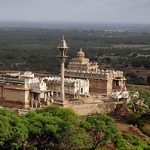
Chandragiri is smaller than Vindhyagiri by 249ft. in height. It is about 175ft. above the plain, and therefore is called Chikkabetta. In Kannada the word Chikka means smaller and betta the hill. Numerous references are found in Sanskrit and Prakrit Jain and non-Jain works about it under the surname of ‘Katavapra’ in the former and ‘Katvalpu’ or ‘Kalvappu’ in the latter.
  • Chamundaraya Basti – It is one among the biggest and handsomest temple of Chandragiri and is dedicated to 22nd Tirthankar Neminath. It was built by Chamundaraya in 982 A.D. A new floor was added to it by his son Jinadeva. In the upper storey Lord Parshwanath is enshrined by Jinadeva. The pillars and the battlements of this temple are carved with numerous fine pieces of Art. This is one of the most ancient temples here and is now under the protection of Archaeological Survey of India.
  • Shantinath basti – It is also a big temple, and built on Hoysala style of Architecture to some extent. An image of Lord Shantinath about 11ft. height is enshrined here in the standing pose. It seems the walls and ceilings had fine paintings once.
  • Chandragupta Basti – It is the smallest temple on Chandragiri. It was so called after the legends pertaining to Acharya Bhadrabahu and Chandragupta Mourya. This is a temple where the most reliable history of the 1st authenticated Emperor was carved on the stone. These carved stone screens gives the history of Chandragupta Mourya and his guru relating to that great migration of 12,000 Jain monks to South about 3rd century B.C.
  • Parshwanath Basti – It is one of the biggest temples of this hill and has an idol of Lord Parshwanath 15 ft. height, canopied by seven hooded cobra. The exterior walls had pilasters are carved with designs and idols are carved in the battlements of the walls. It has an elegant pillar – Manastambha.
  • Kattale Basti – In Kannada ‘Kattale’ means ‘darkness’ and it is so called because of its darkness. This temple is the biggest unique in the respect as it has a Pradakshina Patha around its main shrine. It is dedicated to Lord Adinath and an idol of the same is installed herein. It is 6 ft. height.
  • Shasan Basti – It was built by Gangaraj who named it ‘Indrakulagriha’ in 1137 A.D. He also donated a village of ‘Parama’ for its upkeep. Shasan means an inscription and as there is an inscription at the door of this temple, and hence is so called. Lord Adinath about 5 ft. is enshrined here.
  • Majjigana Basti – It is dedicated to Anantanath. Builder was built by one Majjigana and the year of construction is not known.
  • Chandraprabhu Basti – It was built by Ganga King Shivamara (2) son of Shripurusha in 800 A.D. Lord Chandraprabhu of about 3 ft. height is seated in
  • Eradukatte Basti – It is dedicated to Lord Adinath, it is 5 ft. in height. It was built by Laxmi, the wife of Gangaraja, the defence minister of Hoysala King Vishnuvardhana in 1118 A.D.
  • Savati Gandha Varan Basti – It was built by royal queen Shantala wife of Hoysala King Vishnuvardhana in 1123 A.D. It is dedicated to Lord Bahubai, 5 ft. in height.
  • Terina Basti – Named after the car like stone structure facing it, the temple to the east of Savatigandhavarana basti was built by Macikabbe and Santikakabbe , mothers of two royal merchants, Poysala Setti and Nemi Setti respectively. It was consecrated in 1117 A.D. The Bahubali image in the sanctum is not that of a Tirthankara, but of a Kevali.
  • Iruve Brahmadeva Temple – This temple is outside the walled area. It is to the north of the north entrance to the enclosure. It enshrines a figure of Brahmadeva and was built in 950 A.D. Besides, there are certain small ponds which are also held to be sacred.
  • Bhadrabahu Cave – This is the very cave in which Antima Shrutakevali Bhadrabahu attained Nirvana. His foot-prints are engraved on a slab two spans in length. It is the place where Chandragupta passed his last 12 years in Jain hermitage.
  • Kuge Brahmadeva Stambha – This lofty pillar stands at the south entrance to the enclosure with a seated figure of Brahmadev on the top facing North. Once it had eight elephants supporting its pedestal, but now only a few are left and rest have perished. It is a fine pillar, comprising of a solid shaft beautifully carved into eight segments which three tiers in pedestal.
  • Mahanavami Mantap – To the south of Kattale Basti there are two mantaps side by side facing South. Both contain inscribed slabs in their middle. One of the slabs denotes the place of Sallekhana of Nayakirti Muni.
  • Bharateshwar – This statue about nine feet high facing west is said to be that of Bharateshwar, the elder brother of Bahubali. It rises from knees to head. Though protected by Ancient Monuments Preservation Act, its several features have been deliberately damaged by unknown people.