The Colossus of Lord Gommateshwara stands on Vindhyagiri. The steps lead through two decorative stone-arches and past the first small shrine and the arch as one ascends, they have a panoramic view of the village below with its fine temples, sacred lake and graceful palm.
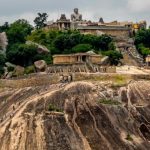
  • Choubis Tirthankara Basti – It is a small shrine wherein the images of twenty-four Tirthankaras are inscribed on a slab of 2.5ft. width. There are three big inscribed images in the lower row, surrounded by twenty-one smaller ones.
  • Oudegal Basti – This is one of the biggest temple on Vindhyagiri, and is so called due to the massive props to its outer wall. It is also called ‘Trikut Basti’ after the three images of Adinath, Shantinath and Neminath seated in Padmasan pose in separate Garbagriha. It is a grand structure and occupies a prominent place on Vindhyagiri. It is praised for its superb architectural art.
  • Chennanna Basti – This temple stands at some distance west of the Tyagada Kamba pillar and was built by Chennanna in 1673 A.D. An idol of Lord Chandraprabhu of about 2.5ft. in height is installed in it. This basti is unique as it has a pillar just before it, and the two pillars of veranda facing each other bear images of a man and a woman with folded hands most probably depicting Chennanna and his wife. It consists of a Garbhagriha, a porch, and a veranda. Both the pillars are about 5ft. in height and bear a number of inscriptions and images of Jain Acharyas
  • Siddhanth Basti – This is a small temple just close to the outer enclosure and the door leading to the inner court of Bahubali. It has a small image of Siddha of 3ft. in height. It has two richly inscribed columns on either side of about 6ft. in height of elegant workmanship.
  • Akhand Bagilu – It means a door without joints, which is literally true about this door. It has been carved out of a single massive boulder of granite and has no joints whatsoever. It is the entrance door to the upper enclosure of Gommateshwar. On the upper half of the pillar there is a fine inscribed figure of Gaja Laxmi seated on a lotus and is being bathed by two elephants standing on either side of her. There are two side shrines of Bahubali and Bharat on its right and left sides.
  • Siddhashila – It is a big slab made out of granite boulder and lies to the right of the Akhand Bagilu. It has numerous inscriptions and images of some of the prominent Jain Achryas with their names.
  • Gullikayajji Bagilu – It got its name after the well-known devotee Gullikayajji and is so called because of an inscribed image of a sitting woman with folded hands on a nearby boulder about one foot in height. It has been mistaken for Gullikayajji because in one of the inscriptions it is referred to that of the daughter of Mallishetti and it commemorates the place of her death.
  • Tyagad Brahmdeva Stambha, also known as ‘Chagad Kamb,’ served as a place for giving alms in ancient times. Builders of shrines or temples would distribute wealth to Pandits and beggars here. The pillar, made of massive stone with intricate carvings, features historical inscriptions. Originally supported in a way allowing a handkerchief to pass beneath, erosion has made this no longer possible.

         After Akhand Bagilu, by the flight of some steps one enters an open court. Here in the centre, there is a great door with an open portico. This is the door of the court in the centre of which stands a mighty Colossus of Lord Bahubali, 58.8 ft. height, hailed as one of the greatest wonders of the world which has made this tiny village of Shravanabelagola a place of pilgrimage not only for Indians but tourists world over.
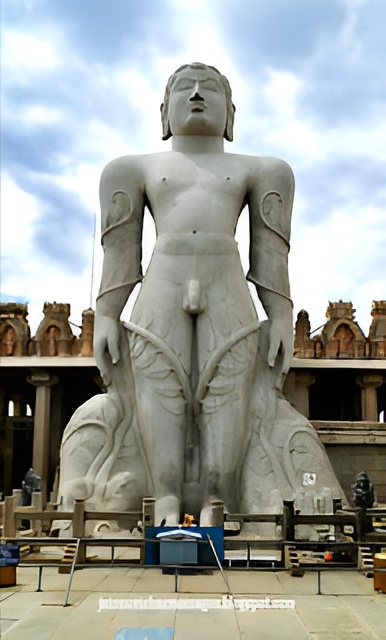
         The Jain Architecture of South India solely belongs to the Dravidian style of architecture. The Colossus represents Gommateshwara, younger brother of Bharata, who, according to Jain mythology was the first man to attain salvation in the current Avasarpini era even before his father Shri Vrishabhadeva. The huge image stands majestically in almost perfect state of preservation. Its height is 58.8 ft.

        The Colossus, carved from a single granite block, depicts the Jain saint Gommateshwara (Bahubali in North India). Perched on Vindhyagiri Hill, its creation remains a mystery due to the steep ascent. The awe-inspiring monument, representing a tranquil Gommateshwara, evokes a sense of wonder and reverence, seemingly indifferent to the observer’s presence.